
Downwind Wine: Issue #12
Quitting, crucibles, crocheted fish, and a little music
Quitting a Race
This is a tale of two races, and an exploration of quitting and not quitting.
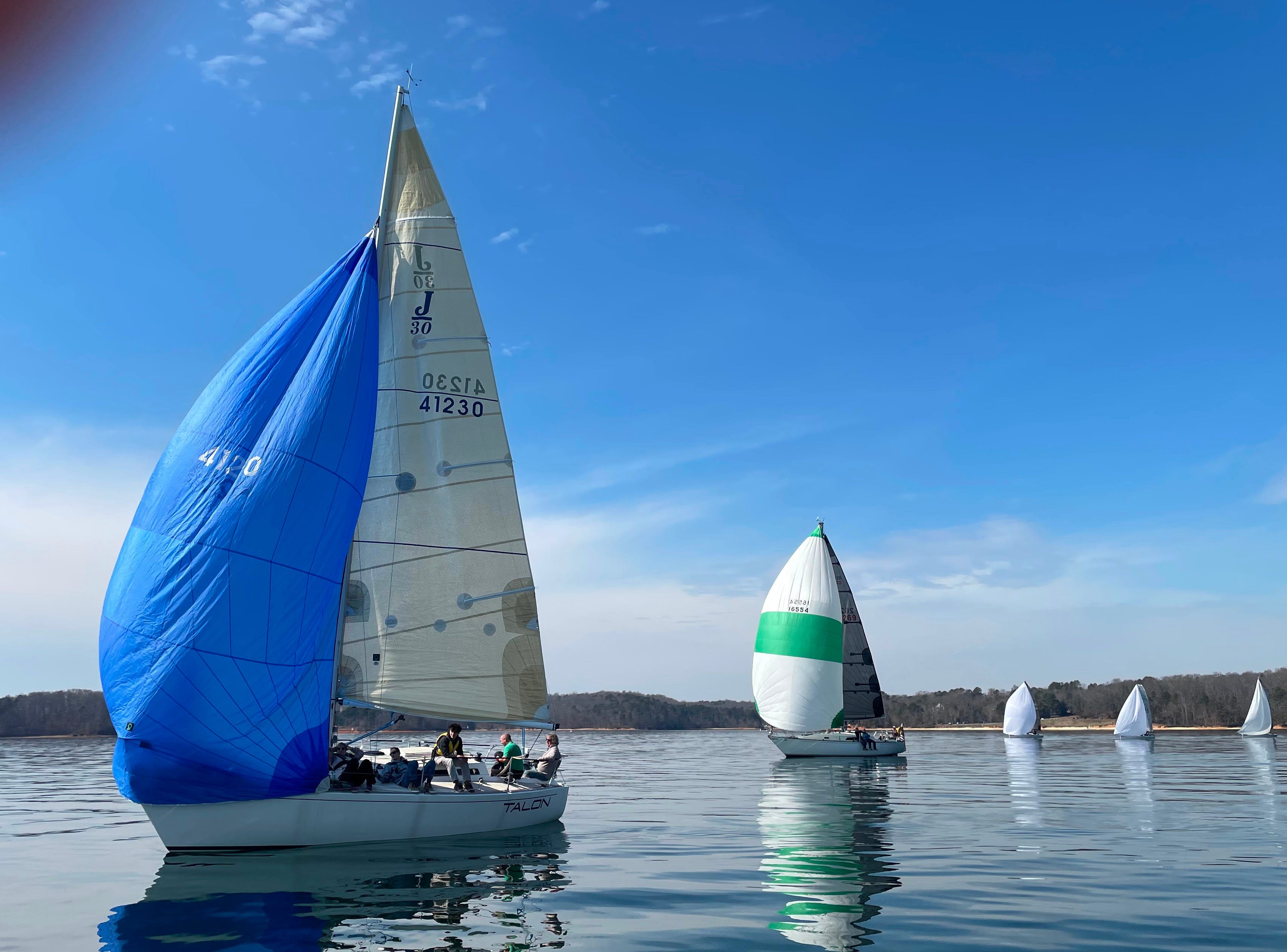
Earlier this month, Team Wind Spinner participated in an event called the Hot Ruddered Bum, a one-day regatta put on by a local club. They planned to run three races, with a party afterward. It was cold, the winds were really blowing, and we were short one crew member, but we reefed the sails and headed out to play.
A brief digression: flat starts vs. pursuit starts
There are two basic ways to set up a race when the scoring involves a handicap adjustment.
In a flat start, the handicap is applied at the end. The race committee sets a line using various buoys and markers, and displays a series of flags to count down to the start time. The boats all jockey for position and cross the line as close to the starting signal as possible. The finish times are then adjusted for the handicap, which means that the boat crossing the line first may not be the ultimate winner.
In a pursuit start, the handicap is applied at the beginning. Each boat has a different starting time that takes the handicap into account, and passes the starting point as close to that time as they can. The boats are then scored in the order of finish.
It took the committee boat quite some time to get anchored and set the line. We ran the first race, coming in second to the only other boat in our fleet. Because the wind had changed, the committee had to move their boat and set a new line for the next race. It took a long time, and it was clear that there would not be a third race. We (and a few of the other boats) ultimately decided to retire before the start of the second race, and went to the party, where we collected our second-place bottle of rum.


The following weekend we had another race; a pursuit start in which multiple fleets ran the course at the same time. The winds were light, and the course was fairly long. Of eight boats registered in our fleet, we were the only one to show up. The other fleets are faster boats that have spinnakers; although we started first, everyone else passed us—we were the last ones out on the course. Quitting would not change the outcome of the race. We ultimately kept going and finished about 30 minutes after the last boat ahead of us.


So here’s the question. Why would we quit in one situation but not in the other? What makes the difference? Here are a few thoughts:
We really don’t like to quit. Our skipper is a former Army Ranger, and we are all pretty committed to finishing what we start. So we have a general bias toward keeping going unless it is dangerous to continue.
On the other hand, we have established clear values on the boat about sailing to both the knot meter (sail fast & win) and the fun meter. It’s always OK for a crew member to speak up and say “hey, there’s nothing about this that is fun!” (In this case, that was me!)
In the first event, the combination of conditions (short-handed, a lot of wind, the race committee taking so long to set things up, etc.) put things over the “not fun” edge. The only real cost of quitting was having to walk into the party with the other sailors knowing we had not finished, and we were OK with that.
In the second event, the desire to be back at the dock sooner was not enough justification to quit, even though it wouldn’t have affected our position in the race.
There were some serendipities. In the first event, the other competitor in our fleet started with the group in front of him—all boats with faster ratings—and he beat them all, which he was quite pleased about. In the second event, as we were drifting toward the finish, we used the time to try out some techniques we hadn’t done before (and we may have poured another glass of wine…)
Questions for Reflection: When have you made a decision to quit a course of action you’ve started? When have you kept going when there would have been few consequences of stopping? What were some of the factors you considered? How did things turn out? Would you make a different decision if you did it again?
Everyday Beauty
Here are some of my favorite “morning walk” pictures from the last few weeks.


Synergy Crucibles
This is one of a continuing series of articles on my explorations into the art and science of synergy. I’ll be starting a course soon that dives into this work and provides practical guidance on how to apply it in a range of settings.
A crucible is a pot in which metals and other substances are heated to very high temperatures for the purpose of melting and/or refining them. This term has become a metaphor for any situation that presents a significant challenge or test, particularly one in which strong forces interact to cause or influence change and development.
Here’s an article I wrote a while back on the concept of crucibles in personal development and resilience.
When an effort to bring together varied perspectives has the potential to be explosive—for example, when highly contentious political issues, emotionally-laden topics, or tough negotiations are involved—it’s very important to intentionally and systematically construct a container that can hold the tension and keep people engaged in the process even when it’s difficult. In previous posts I’ve talked about common goals and interdependence. These are two of the elements that need to be in place to create an environment in which collaborators are motivated to invest themselves deeply in the work without giving up and walking away.
The late David Schnarch, a therapist and author of Passionate Marriage: Keeping Love & Intimacy Alive in Committed Relationships, uses the metaphor of the crucible to describe the process by which couples can use relationship challenges as a catalyst for growth. Rather than viewing relationship difficulties as indications of incompatibility, Schnarch views them as necessary stepping stones to deep love, intimacy, and passion in marriage. He is very clear that the commitment to remain in the relationship creates a container in which the work is done.
Questions for Reflection: Have you been in situations that served as crucibles for personal, team, or organizational development? What were the conditions that helped create this environment? What outcomes grew out of the struggle? As you look around, where might it be important to build crucibles in the world around us and invite people to come into them?
Lately my brain has been traveling to a pretty offbeat set of places. Here are a few of the things I’ve collected to share.
Haskell Indians

I recently flew from Tampa to Atlanta, and saw a group of young people boarding the plane who looked like they were heading home from an athletic event. Their outfits said Haskell, with the logo I’ve included above. My curiosity led me to a quick online search, and I learned about Haskell Indian Nations University, located in Lawrence, KS. The oldest continually operating federal school for American Indians, it is a fascinating reflection of our country’s history with Native American students. When Haskell was founded in 1884, the government’s focus was on assimilating young people into the majority culture and training them for trades and homemaking. During the 1960s, Native Americans worked to reshape the approach. Over the next thirty years, it became a junior college and then a four-year bachelor-degree granting university, with a focus on serving Native American and Alaska Native goals, including programs focused on Indigenous history, art, and language revitalization. Approximately 140 Tribal nations and Alaska Native communities are represented there. Along the way, it became famous for its football teams—from 1902 to 1919, Haskell won five of eleven games played against the University of Texas. Although the football program was suspended in 2015 due to funding shortfalls, the Fighting Indians compete in 11 intercollegiate varsity sports.
NPS Crochet
Today I laughed out loud when I ran across a series of crochet patterns from the National Park Service. I particularly liked the fish—a walleye and a halibut, but there are a bunch more, including a beaver and a cactus!


How a Mountain Fiddler Inspired Aaron Copland
I ran across this story on my musical rambles. Here’s the description that accompanies the video on YouTube.
In 1937, a Kentucky fiddler named William Hamilton Stepp played a tune called "Bonaparte’s Retreat" for a field recording project. That raw, powerful performance — recorded in a single take — would later inspire composer Aaron Copland to create one of America’s most iconic orchestral works: “Hoe-Down” from Rodeo.
But who was Stepp? How did a self-taught mountain fiddler end up shaping the post-war classical music of an entire nation? And why has his name nearly disappeared from music history? In this video, we uncover the story behind the man, the music, and the moment that connected folk tradition to the concert hall.
On a recent family Zoom call, we got completely overwhelmed with laughter remembering the Carol Burnett Went with the Wind / Curtains episode.
Here’s a great example of the art of reframing—finding a different way to view something that makes it feel more positive. Meet the travelers who have come to enjoy and appreciate the joys of airline flights, including middle seats, airplane food, and turbulence.
Just for the Sheer Beauty of It
I’ll close with this. Aaaaaahhhhhhh!